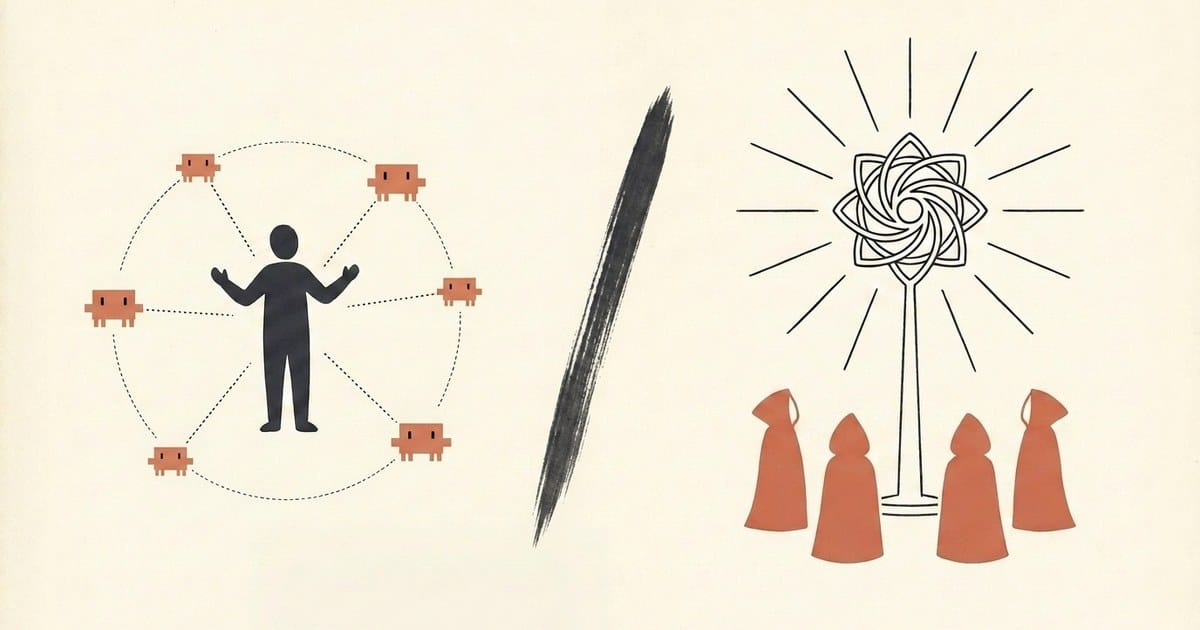
Two AI futures
There are two visions for the future:
- AI as a deity built and controlled by a small group of clergy
- Humans at the center with AI as an amplifier
A new technical clergy is emerging: the small group that builds frontier systems, receives privileged access to them, and decides which capabilities everyone else may use.
The clergy warn about mass unemploymentDario Amodei warned that AI could eliminate half of entry-level white-collar jobs within five years (May 2025). Sam Altman said AI means customer support jobs are “totally, totally gone” (July 2025). Mustafa Suleyman predicted most computer-based professional work will be fully automated within 18 months (May 2026). Elon Musk proposed “universal high income” as the remedy (April 2026).. They don’t think it will necessarily lead to a bad outcome. Freeing people from grunt work can liberate time for pursuing leisure activities.
The average person hears mass unemployment as catastrophic. How do they make rent or buy food for their kids? We are assured that abundance, redistribution, and new forms of meaning will compensateSam Altman’s “Moore’s Law for Everything” (2021) promises to “directly distribute ownership and wealth to citizens”; his “The Gentle Singularity” (2025) foresees intelligence becoming “wildly abundant”; Dario Amodei’s “Machines of Loving Grace” (2024) addresses work and meaning after displacement.—by the grace of the machines and their controllers.
A tiny group mediates between machine intelligence and everyone else. Humanity does not broadly participate in directing that intelligence or deciding how it should be used. Most people become recipients of decisions, products, and abundance. Not participants.
Initially the clergy may administer the machine. But as its capabilities surpass their own, it becomes less clear who is directing whom. In this vision, they build a deity, and increasingly their role is to tend it, interpret it, and decide who may approach it.
There’s another path: not one central intelligence ruling over billions of passive users, but billions of humans learning to direct capable agents of their own.
The future is unevenly distributed
The clergy focus feverishly on sharpening the tip of the spear so it can pierce ever harder domains: solving century-old mathematical problemsIn January 2026, Erdős Problem #728 became the first Erdős problem fully resolved autonomously by AI (GPT-5.2 Pro plus Harmonic's Aristotle, formalized in Lean). In May 2026, an OpenAI model resolved an Erdős problem that had been open for 80 years. and finding software vulnerabilities undiscovered for 30 yearsAnthropic's Frontier Red Team reported that Claude Opus 4.6 found 500+ high-severity vulnerabilities in heavily fuzzed production open-source code, some undetected for decades. Claude Mythos Preview then found thousands of zero-days across every major OS and browser, including a 27-year-old OpenBSD bug.. They will undoubtedly cure diseasesDemis Hassabis on 60 Minutes (April 2025): the end of disease is “within reach… maybe within the next decade or so”. His Isomorphic Labs raised $2.1 billion in May 2026 toward “solving all disease”. and generate immense value and wealth. But who will have access to the cure for cancer? And the cure for aging? Drug discovery capabilities are restricted because of bioweapons risksAnthropic activated ASL-3 protections with Claude Opus 4, deploying classifiers that constrain biology-adjacent capabilities to limit CBRN weapons risk. The pattern deepened with the Claude 5 generation: Fable 5 ships with safety classifiers on dual-use capabilities, while the unrestricted Mythos 5 is available only to approved organizations.. Software capabilities because of cyber risk. It’s not hard to see what comes next: math capabilities limited because of cryptographic risks, creative capabilities because of disinformation riskOpenAI restricted Sora to opt-in consent for likenesses after deepfake complaints from SAG-AFTRA and celebrity estates (October 2025); NewsGuard found Sora produced videos advancing 16 of 20 false claims tested; the EU AI Act’s Article 50 deepfake-disclosure mandate takes effect August 2026..
Governments required many of these restrictions, and frontier labs often supported themAhead of GPT-5.6’s launch, OpenAI proactively previewed the models’ capabilities with the US government; the models were OpenAI’s first rated “High” risk in both biology and cybersecurity, and the rollout began with roughly 20 government-approved partners (Forbes)..
At the same time, selected partners, researchers, and institutions retained access to capabilitiesAnthropic's Project Glasswing initially limited Mythos Preview to a small group of critical industry partners and open source developers. After Fable 5 reached general availability, a US export-control order forced Anthropic to disable Fable 5 and Mythos 5 worldwide; when the ban lifted, Mythos 5 returned only for government-approved organizations. OpenAI's GPT-5.6 followed the same shape: a government-requested limited preview for roughly 20 partners before general availability on July 9.. The result is the beginning of a two-tiered system: frontier AI for a small group, constrained AI for everyone else.
There are real dangers in making powerful capabilities universally available. Biosecurity is real. Cybersecurity is real. Disinformation is real. But genuine safety concerns shouldn’t lead to exclusion and permanent dependency.
The frontier is racing ahead. The median is standing still.
The vast majority of humans don’t know how to use the ever-sharpened spear.
Software development gives us a peek into the future, because software developers got AI agents a year before everyone elseCursor shipped its first agent mode in November 2024 and Anthropic released Claude Code in February 2025; general knowledge workers got the equivalent only when Claude Cowork, “Claude Code for the rest of your work,” launched in January 2026.. Initially the developers who were the most effective at working with agents, the super users, were maybe twice as productive. Over the past year and a half that’s steadily increased to a 5x increase, then 10x.
The best agentic developers are now probably exceeding 100x, doing massive rewrites of codebases that would have taken years of engineering in daysBun, 535,496 lines of Zig, was rewritten in Rust in 11 days by one engineer supervising up to 64 concurrent Claude Code instances, with the 6,755-commit pull request passing the full test suite on all platforms. Jarred Sumner’s estimate for doing it by hand: 3 engineers for about a year, roughly 750 engineer-days compressed into 11..
I created NanoClaw over a weekend of intensive coding First commit: Saturday, January 31, 2026. Launched on Hacker News the next day.. Although the project has few lines of code, it covers many technologies I had minimal or no prior experience with (Baileys, SQLite, Apple containers, IPC). Starting with the knowledge I had that Friday night, building it pre-AI would have taken me six to eight months. More realistically, I would never have completed it.
But those developers are a tiny fraction. My sense is far less than one percent have reached 100x. The median developer hasn’t gained any meaningful increase at allMETR’s randomized trial found experienced developers were 19% slower with AI tools in early 2025; its February 2026 follow-up found only “very weak evidence” of modest speedups.. They’re still within a rounding error of 1x. Every week there’s a new release of a model or a feature. 4.6, 4.8, 5.5, fable, Sol. Hooks, Skills, loops, workflows. With each release the super user unlocks a new level, while the median just gets more confused and the gap keeps growing.
The same thing that’s played out for developers with coding agents has started to play out across the workforce. We’re already hearing about 10x salespeople, 100x marketersAnthropic’s own case study describes a single growth marketer running its performance marketing at scale with Claude Code (“What used to take 30 minutes per ad now takes 30 seconds”), which circulated virally as “Anthropic’s entire growth marketing team was one person.”. But the average person in the workplace is still using Copilot with a personal $20 a month ChatGPT or Claude subscription on the sideOkta’s March 2026 survey of knowledge workers across seven countries found 52% admit to using unapproved AI tools at work (67% in the US), while 90% of executives were confident they had visibility into AI use..
The median hasn’t budged. And a handful of 10x outliers barely moves the average. Making a smaller and smaller group of people more and more productive is not the best way to move the average. The way to move the average is to make the median person 2x.
The future is built, not announced
Having a very sharp spear is a good thing. Curing cancer is a good thing. But we shouldn’t let the clergy dictate the vision and the direction for the world we all build. And we don’t have to.
Most people do not need another order of magnitude of model intelligence. They need the intelligence we already have made usable and integrated into their work.
We do not have to accept the vision for the future that the clergy have prophesied, declared as fate, and are racing to build.
This is not only a question of who gets access to AI. It is a question of who participates in building with it. The current trajectory is a widening gap: fewer and fewer people doing more and more. That trend needs to be reversed.
The future should not only be built for billions of people. It should be built by billions of people. We need universal participation, not just universal access.
Build the internet for agents. Build agents for humans.
What should the future of humanity look like?
Humans at the center with AI as an amplifier of human creativity, productivity and prosperity.
Build products for agents. Build your website for agents. Build the internet for agents.
But build agents for humans.
The shape of our future with AI is being decided one product decision, one deployment, one sales call, one hire at a time.
If you are building AI products, build for the median user, not only the power user.
Design so the user gains judgment and control.
Design for the person managing the agent, not for the agent replacing the person.
Put the human at the center: they set the objective, they review the work, they own the result.
And default to the user owning what matters: the agent’s identity, memory, skills, artifacts, and history.
This is not just about building for the better future, it’s also the better strategy. There are orders of magnitude more people who have never interacted with an agent than there are superusers of Claude Code.
If you’re an AI startup going into sales calls telling execs that you’re going to replace their team with agents - stop.
If you’re an executive asking an overeager startup founder how their agents can replace your team - stop.
This leads nowhere goodKlarna famously cut support staff claiming its AI did the work of 700 agents, then admitted lower quality and resumed hiring humans. By 2026 the reversals were a trend: 55% of leaders who made AI-driven redundancies now admit those decisions were wrong (Orgvue), and 32% of US hiring managers who cut a role for AI later rehired for it (Robert Half).. Even if it could work, is that the future you want to build?
There’s a better way.
Focusing primarily on reducing costs is missing the much bigger opportunity. A company whose only AI strategy is headcount reduction is using an exponential technology for a linear goal.
The fastest and best path to 2x your company is to make the median person 2x.
Not your agents, not your company
Who’s managing the agents?
If it’s not your team managing the agents, then your vendor is managing them. And your company is becoming redundant. You’ve given someone else valuable access, knowledge, and data that helps automate you out of existence. This is the clergy pattern: a small group outside your walls mediating between your people and the intelligence they depend on. Each company that accepts this arrangement disenfranchises its own people, takes its humans out of the loop, and moves all of us a small step toward that future.
So you could say you’ll only automate things on the periphery, not the core value engine of your company.
But then that’s really a cost-saving strategy, not a growth strategy.
You need agents for the core growth engine of your business. And they need to be managed by you and your team. They need to be your agents, not somebody else’s. And you need to focus on growth, not reducing headcount. You need fewer humans doing manual work. But you need more agents and more agent managers. And the best people to be those agent managers are the people who are currently doing the work. They have deep knowledge and domain expertise. They have experience. They have relationships.
But they need to learn to become managers.
Every person becomes an agent manager
You have managed people. You’ve managed projects.
You know how to communicate what you want clearly. You know how to do systems thinking. You know how to give feedback. You know how to review others’ work. And you know to take responsibility for the output of those working for you.
Those are skills you develop as a manager. And those are the skills needed to effectively manage agents.
So each person on your team needs to learn to work with agents. And they need to become an agent manager.
The way to get started is to give each person on the team their first agent. Not in a group, but one-to-one. Their agent, owned by your company and issued to them, that they manage and that helps them do their work.
Over time, your agent managers will manage a second and third agent. When they’re good at managing and improving their agents, some of those agents join the team channel. When they’ve earned trust, a few run public-facing agents.
The best agent managers will manage a team of agents, and then a department.
That’s the starting point. Each person managing their own agent. Not agents thrown into workflows and channels with an unclear chain of ownership, responsibility and control. Agents managed by people. Owned, controlled, accountable.
Sovereign agents
Disclosure: this is what my company builds.
Your agents need to be sovereign. Your company must own and control the agents’ identities, permissions, memory, skills, artifacts, and audit trails. Those assets must be portable, governable, and inaccessible to anyone you have not authorized.
Agents owned and controlled by your company. With your company’s humans at the center.
This is one possible vision for the future. I don’t believe in fate. It’s not me looking into a crystal ball and prophesying about what will be. It’s how I want things to be and what my company and the humans and agents we manage are all working hard to make a reality.
The future has not been decided
Intelligence could be concentrated, restricted, and handed down to us. Or it can be placed in the hands of billions of people and used to increase human agency.
We can cure disease. We can create unimaginable prosperity. We can build organizations in which every person becomes more capable, not more disposable.
But that future will not arrive by itself.
So don’t accept prophecy as policy.
Don’t mistake concentration for safety.
Do not go quietly into the AI night.
Put humans at the center.
Give them agents.
Teach them to lead.