Now Playing

Must-Know Message Broker Patterns

Must-Know Message Broker Patterns

blog.bytebytego.comByteByteGo
0:000:00
Transcript

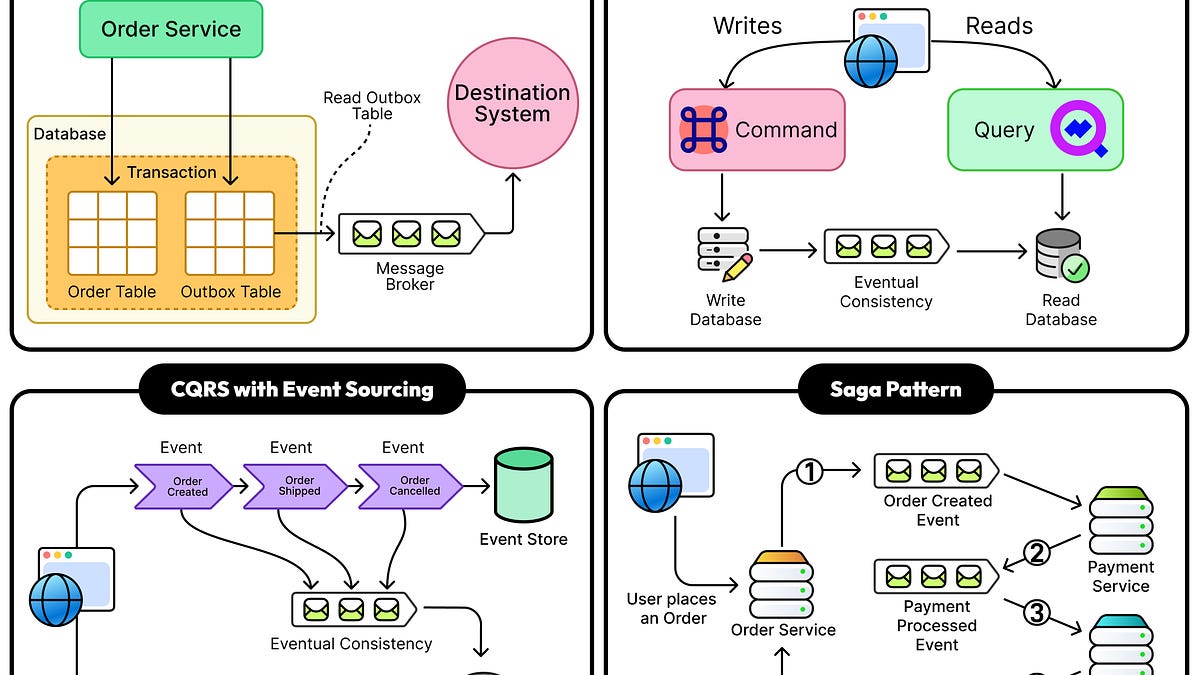
Speaker 1: Up next, we have a look at a piece from ByteByteGo about message broker patterns. It explores how distributed systems communicate effectively, which is basically the backbone of how modern apps work. Speaker 2: I've heard the term message broker before, but I usually just think of it as a middleman. Why is it so critical to have specific patterns for using them? Speaker 1: Think of it like a massive logistics hub for a delivery company. If every driver just showed up at the warehouse at the same time and tried to grab packages, it would be chaos. You need a system—a set of rules—to manage how those packages are sorted, stored, and handed off. Speaker 2: That makes sense. So these patterns are essentially the rules of the road for data moving between different services? Speaker 1: Exactly. The article highlights seven essential patterns that solve three big problems: keeping data consistent, managing heavy workloads, and maintaining visibility into what's actually happening. Speaker 2: Data consistency seems like the hardest one. If I buy something on an app, how do we make sure the inventory and the payment systems stay on the same page? Speaker 1: That's a classic challenge. One pattern involves using the broker as a source of truth where messages are stored until every service confirms they've processed the update. It's like a shared ledger that ensures no one forgets their part of the job, even if a specific service crashes for a minute. Speaker 2: So it acts as a buffer that prevents data from just vanishing into thin air. What about when a site gets a massive surge in traffic, like during a holiday sale? Speaker 1: That's where workload management patterns come in. Instead of one service trying to handle a million requests at once, you can use a pattern that distributes those tasks across dozens of identical workers. It's like opening more checkout lanes at a grocery store the moment the line gets too long. Speaker 2: It sounds like these patterns are really about building resilience into the system. But how do engineers know if something is actually going wrong deep inside those queues? Speaker 1: That's the visibility aspect. There are patterns specifically for monitoring the flow and tracing a single message's journey from start to finish. Without that, you're basically flying blind in a very complex environment. Speaker 2: It's fascinating how much of our digital experience relies on this invisible coordination. It really turns a fragile set of connections into a robust infrastructure. Speaker 1: It really does. Understanding these patterns is what allows developers to build systems that are not only scalable but also incredibly reliable under pressure.