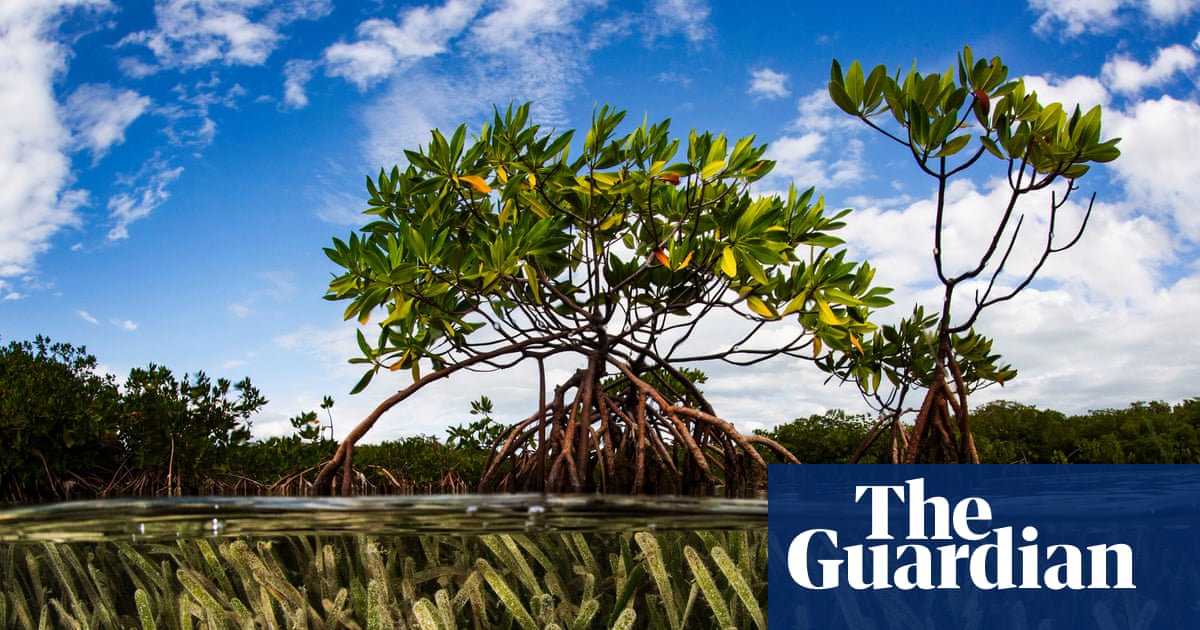
A picture taken half above and half below the waterline, showing a mangrove tree with tangled roots above and seagrass below
Mangrove photography awards 2026 – in pictures
A selection of the winners, runners-up and highly commended photos from the Mangrove photography awards, run by the Mangrove Action Project, which received 5,258 entries from 87 countries. In its 12th year, the awards continue to offer a window into landscapes viewers may otherwise never encounter
Two Worlds, One Ecosystem by Jake Stout. Photograph: MPOTY
Fri 24 Jul 2026 04.00 EDT Last modified on Fri 24 Jul 2026 09.54 EDT
Mangrove photographer of the year 2026 – overall winner Tangled Glow: When Life Meets the Ruins Gaurav Patil, India A ‘ghost’ fishing net glowing under ultraviolet light, tangled in a mangrove on the tide-swept shore of Nandgaon village, Maharashtra, south of Mumbai, has won this year’s Mangrove photography awards. Captured on a 13-second UV exposure, the image reveals a quieter conservation crisis: discarded nets carried in by currents and trapped in mangroves, turning these vital coastal barriers into hidden garbage hotspots. While the impact of ‘ghost gear’ – fishing equipment such as nets discarded in the ocean – on open-water marine life is increasingly documented, its accumulation in mangrove ecosystems on India’s coast has received far less attention. Mangroves sit at the interface between land and sea, meaning they can end up receiving waste from both directions. ‘I came across this particular mangrove patch where discarded fishing nets were getting trapped during high tide,’ said the photographer Gaurav Patil. ‘These nets meet the oceanic currents, which bring them to the coast. I have been watching ghost nets getting trapped in mangroves for the last several years, and I wanted to document it in an artistic manner to grab the attention of the viewers.’ Photograph: Gaurav Patil/MPOTY
Wildlife, other species – highly commended Mudskippers in Awe! Ashok Behera, India Two mudskippers face off on wet mud, mouths agape and fins raised in a territorial display, their blue-spotted patterns catching the light. A vivid glimpse of the tidal flats of the Sundarbans – the world’s largest contiguous mangrove forest – where these fish walk, jump and breathe on land Photograph: Ashok Behera/MPOTY
Underwater – winner Feeding Grounds Under the Canopy Ewan Tregarot, Netherlands Antilles Grey snappers hunt through a school of bait fish beneath the mangrove canopy of Lac Bay, Bonaire. The image was captured during a fish monitoring survey, as shafts of midday light revealed predator-prey interactions usually hidden in these submerged forests. A reminder that Bonaire’s celebrated reefs depend on the mangroves that shelter and feed them Photograph: Ewan Tregarot/MPOTY
People, Conservation & Restoration – winnerSeeds of hope from a coastal village Garry Lotulung, Indonesia Pasijah, 56, plants mangrove seedlings beside her flooded home in Bedono, Demak, Central Java — one of the last residents remaining after more than 200 families left as rising seas and land subsidence submerged the village. She’s planted mangroves since 2000, watching her family’s rice fields turn to ponds and then disappear. In 2021, she and her son planted 15,000 seedlings in a single day; by morning, the waves had washed them all away. Photograph: Garry Lotulung/MPOTY
Young mangrove photographer of the year – winner Adaptation Katanyou Wuttichaitanakorn, Thailand In mangrove forests where warm-blooded prey is scarce, some mosquitoes have adapted to feed instead on cold-blooded mudskippers, as captured here after the photographer set out to discover what was sustaining the forest’s large mosquito population Photograph: Katanyou Wuttichaitanakorn/MPOTY
Wildlife, mammals – runner-up Fast Asleep Kerron Noel, Trinidad and Tobago A silky anteater ( Cyclopes didactylus ) asleep on a red mangrove tree at the Caroni bird sanctuary, Caroni swamp. Though the silky anteater is classified globally as a species of ‘least concern’ by the International Union for Conservation of Nature, it still faces significant risk in Trinidad due to habitat destruction, forest fires and illegal hunting. Silky anteaters are the smallest species of anteater in the world Photograph: Kerron Noel/MPOTY
Portfolio stories – winner From Pillars in the Sea Nicoló Brugnara, India In Versova Koliwada, an elder prays among rows of drying Bombay duck ( Harpadon nehereus ) hung on bamboo racks. For generations, the Koli have preserved fish this way, but as seas warm and coasts urbanise, fishing livelihoods become less viable Photograph: Nicolò Brugnara/MPOTY
Portfolio stories – winner From Pillars in the Sea Nicoló Brugnara, India Hundreds gathered at Charkop’s Turzon Point to oppose the 26km coastal road project and protest against a pattern of approvals made without consulting those who live closest to what is being lost Photograph: nicolo.brugnara/MPOTY
Wildlife, other species – winner Seeking Refuge in the Mangroves Evan Cooper, Bahamas A juvenile green turtle in a shallow Bahamian mangrove forest near sunset during high tide. As the water levels rise and the tide comes in, the mangroves’ roots transform from a barren buffer to a flourishing ecosystem home to sea turtles, crustaceans, fish and much more. Given its size, this turtle has probably arrived here from the Sargasso Sea. The mangrove forest provides shelter for little green turtles like this one from tiger sharks and other predators Photograph: Evan Cooper/MPOTY
Wildlife mammals – winner Where the Mangroves Begin Kallol Mukherjee, India Two jungle cat kittens emerge from the dense mangrove forest in the Sundarban tiger reserve. It is a rare glimpse of the smaller, lesser-known wildlife that shares this tidal landscape with the reserve’s tigers, and survives its shifting mud, saline water and daily tidal flooding Photograph: Kallol Mukherjee/MPOTY
Landscape on the ground – winner Beneath Ancient Light Ryuhei Suguri, Indonesia Under the Milky Way, a solitary mangrove stands in shallow tidal water, its reflection still in the low tide — a quiet pairing of ancient starlight with one of Earth’s most vital coastal ecosystems Photograph: Ryuhei Suguri/MPOTY
Wildlife, birds – winner March of the Flamingos Mark Ian Cook, United States A small group of American flamingos peer at a juvenile lemon shark while searching for suitable foraging habitat in the mangrove-lined shallow backwaters of Florida Bay Photograph: Mark Ian Cook/MPOTY
Threats – winner Red Mangrove Harvest Zafer Kizilkaya, Bangladesh Illegal red mangrove harvesting in the Sundarbans, Bangladesh — a Unesco World Heritage site and home to about 125 Bengal tigers. Weak enforcement lets the trade continue, feeding a local charcoal industry, driving deforestation, and fuelling the region’s high rate of human-tiger conflicts Photograph: Zafer Kizilkaya/MPOTY
Landscape black and white – winner Footprint of the Earth Abijith Soman, India An island shaped like a footprint emerges from Kerala’s backwaters, its mangroves tracing the toes and sole of the print. Many of these islands were once mangrove forest before being cleared for coconut plantations — on some, the mangroves are now reclaiming that ground. A quiet mark of where nature is stepping back in Photograph: Abijith Soman/MPOTY
People and livelihoods – winner String of Crabs Roosevelt Cassio, Brazil A fisher shows off the day’s catch — a batch of crabs known locally as a ‘corda’, sold for about R$20 in Brazil Photograph: Roosevelt Cassio/MPOTY
Landscape, from the air – winner Mangue Beat Lucas Gonçalves Garcias, Brazil Aerial view of the Tejipió River in Recife, dividing shrimp ponds maintained by residents of Ilha de Deus — many of whom depend on the ecosystem’s health for their livelihood — from a stretch of mangrove forest partly filled in for a naval zone. The varied colours of the ponds trace different stages and depths of shrimp farming Photograph: MPOTY
Black and white – runner-up Root of the Solution Vladimir Borzykin, Thailand Photographed close to the mangrove floor, this image strips away horizon and scale to focus entirely on the exposed roots — tangled at first glance, but revealing structure and rhythm the longer you look Photograph: Vladimir Borzykin/MPOTY
Underwater – highly commended Two Worlds, One Ecosystem Jake Stout, Cuba A split shot reveals the two often-overlooked halves of a mangrove ecosystem: the tangled roots above, and the seagrass bed below — a transitional nursery where juvenile fish shelter before graduating to nearby coral reefs. Photographed in Cuba’s Jardines de la Reina, a marine protected area since 1996, where strong protection has produced some of the Caribbean’s richest biodiversity Photograph: Jake Stout/MPOTY